

In this article
- 200 Hour Certification Basics
- Beyond the 200 Hour: Advanced Training Costs
- Format Matters: In Person, Online, or Hybrid
- Location Strongly Shapes Your Investment
- What Your Training Usually Includes
- Factors That Increase Training Costs
- Hidden Costs People Do Not Always Expect
- Smart Ways to Reduce Your Training Investment
- What You Can Expect to Earn as a Yoga Teacher
- When Training Is Not About Teaching Income
- Red Flags: When Cheap Is Not a Good Deal
- Choosing Your Program: Beyond Cost
- Styles and Specializations: How They Affect Cost
- Making Your Decision
- Frequently Asked Questions
- How long does it take to recoup the cost of training?
- Why is training in India so much cheaper?
- Do I need Yoga Alliance certification to teach?
- Can I teach right after my 200 hour training?
- Are weekend programs as good as intensive programs?
- What is the average class size for teacher training?
- Do programs offer refunds if I withdraw?
- How much do yoga teachers actually earn?
- Is online or in person training better?
- Can I work while completing training?
Here you are, thinking about a yoga teacher training. You might feel called to teach or you might simply want a deeper practice, people feel called to do trainings for a variety of reasons. You have probably looked up what yoga teacher training costs and found everything from $99 all the way to $11,000. The cost part can feel very confusing, so we wanted to share what all of the numbers mean so it’s easier to choose the training that is best for you.
200 Hour Certification Basics
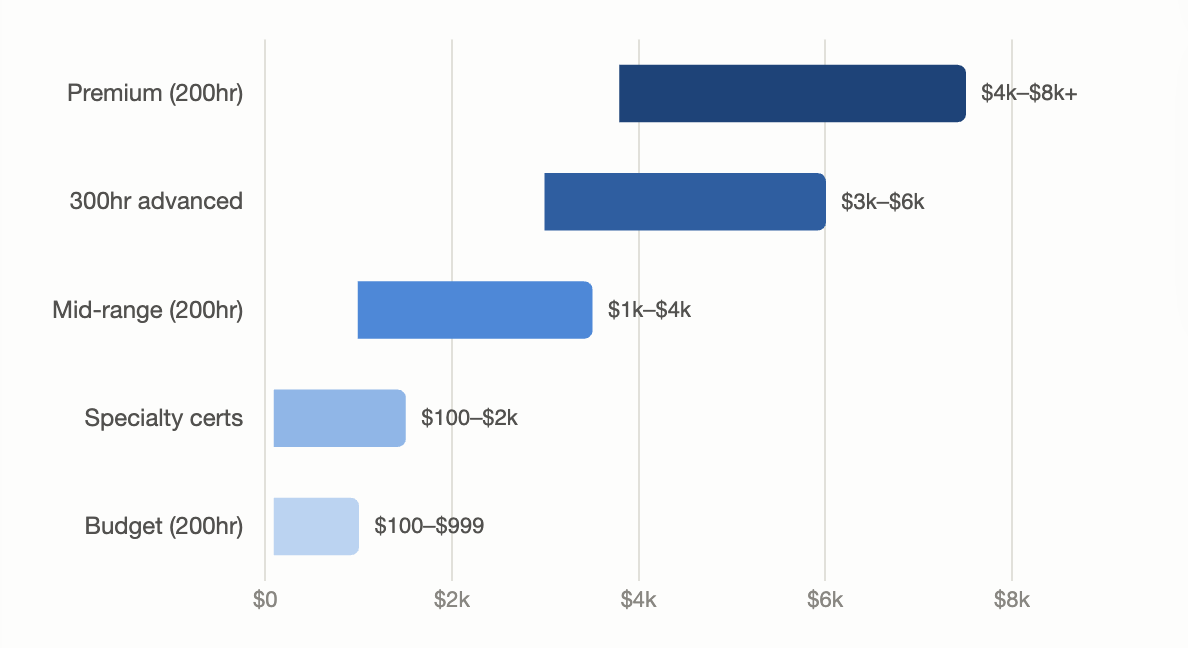
Budget Programs: $100 to $999
These programs have become common and some are solid, as long as they offer what you are seeking. For example, YogaRenew starts at $425 while ExpertRating is $99. What can be helpful for some is that most of these programs are online and self paced with pre recorded lessons which is good if you need flexibility. You receive a certificate once you’ve completed the program that covers basic curriculum.
What you won’t receive is live feedback, personalized support or hands on teaching practice. You likely will not get community connection either. So, if you are looking for connection and support, these programs are not going to be the strongest in those areas.
I have taught many students who started here. From what I noticed, they understood the information but needed a lot of support to build real teaching skills. This level works if you are self driven and already have a strong foundation or have a place to receive mentorship in addition to this training pathway.
Mid Range Programs: $1,000 to $3,500
You have likely seen that most teacher trainings fall into this range. The popular brand CorePower starts at $3,099. You’ll find that many local studios offer programs between $2,000 – $3,000. And the majority of online programs average around $1,500.
The mid range programs usually provide live instruction, direct feedback, smaller group learning, with structured teaching practice. Topics covered are the foundations in anatomy, methodology, philosophy, and business basics are usually included.
My first 200 hour training was in this range and the live teaching practice shaped everything for me once I began leading classes, which I did not realize until I got there.
Premium Programs: $3,800 to $7,000 and higher
These are often retreat style trainings in places like Costa Rica or Bali. While the price tag on the actual training might appear less, we have the cost reflecting lodging, meals, intensive study, and often, access to very experienced teachers.
Bikram training ranges from $4,000 to $10,900. Iyengar certification can be $5,000 and higher due to the rigorous assessment system and close mentorship. You are also paying for the brand when you are making this purchase.
A higher price does not always equal better teaching, but it often means more personal attention and a powerful immersive experience.
Beyond the 200 Hour: Advanced Training Costs
After you complete your foundational training, you may feel ready to study at a deeper level as many people do.
300 Hour Advanced Certification
These programs usually cost between $3,000 to $6,000. Typically, you will study advanced anatomy, sequencing, therapeutic approaches, and specialized teaching skills. When you combine this with your 200 hour training, you qualify as a 500 hour teacher through Yoga Alliance.
Many teachers wait one to three years before enrolling. This gives them time to teach real students, integrate what they learned in their 200 hour training, and understand how those teachings live in their own body and voice. With that foundation, the advanced work becomes more meaningful and impactful.
Specialty Certifications: 50 to 100 Hours
Examples of specialty certifications are Prenatal yoga which ranges from $100 to $1,500. Trauma informed programs, chair yoga, and aerial yoga fall in a similar range.
These trainings are shorter and allow you to specialize without the time or cost of another full program.
I added prenatal training a few years into teaching because several of my students were asking for pregnancy safe classes. It was a simple, and fulfilling, addition to my training.
Format Matters: In Person, Online, or Hybrid
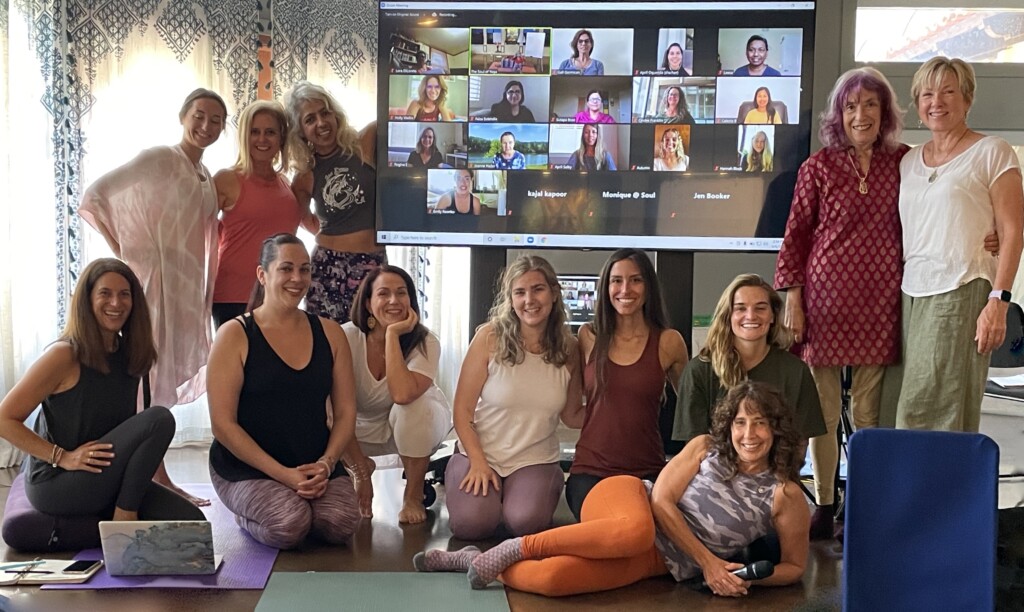
In Persona and Online Yoga Teacher Training
In Person Local Programs: $1,000 to $7,000
Local studio programs spread over several weekends cost around $2,500 – $4,500. You train once or twice each week often while keeping your normal schedule.
There are also local immersive programs that take place over four to six weeks at retreat centers. The higher cost reflects lodging, meals, and the pace of study.
The benefit to either of these options is real time feedback and physical adjustments and you can build strong relationships with your cohort. The challenge can be scheduling because the weekend programs require several months and intensives require you to push the pause button on the daily demands of life.
Online Training: $200 to $2,500
Self-paced online programs usually range from $199 to $1,000. Live online training with scheduled sessions is typically $2,000 to $3,500. You save on travel and accommodation, and you can train from anywhere. You also lose the experience of physical adjustments and the shared energy that comes from being in the room together.
I have taught many students who completed online training. They tend to have strong theoretical knowledge, but they often feel less confident with hands-on assists and with reading a group of students in real time. Online training works well if you are already an experienced practitioner who learns independently. It is more challenging if you are newer to yoga or rely on external accountability.
Hybrid Programs: $1,000 to $5,000 dollars
These programs mix online coursework with required in person sessions. In person usually means that you must be with the training live either streaming online or physically in a space. You might complete most of the material online, then attend a short intensive for hands on work. This option gives you flexibility while still offering live guidance. The cost usually lands between pure online study and fully in person formats.

Location Strongly Shapes Your Investment
India: $1,200 to $2,000 for 200 hours
Rishikesh offers reputable 200 hour programs in this range and they often include lodging and meals. You study in the homeland of yoga with skilled teachers at a much lower cost than Western programs.
Flights to India from the United States are generally cost $800 – $1,500, in addition to visa costs, travel insurance and time away from work. Most people spend $3,000 to $4,000 total for a month-long immersive training. Several of my friends trained in Rishikesh and felt changed by the experience.
Southeast Asia and Central America: $1,500 to $3,000 dollars
Bali, Thailand, Mexico, and Costa Rica offer programs in this range. These programs attract international students and are held in beautiful locations.
You want to be prepared to pay for the destination as much as the training. If you want learning paired with a retreat style experience, these work well. If your priority is education, local programs often offer stronger value.
United States: $2,500 to $4,000 locally, higher in major cities
Programs in large cities like New York, Los Angeles, and San Francisco can reach $6,000 to $7,000. Smaller cities and suburban studios usually stay closer to $2,500 – $3,000.
This way, you can avoid travel costs, but you pay for higher studio expenses and higher teacher compensation.

What Your Training Usually Includes
Almost Always Included
Programs usually provide workbooks, texts, and teaching guides. You also receive a certificate when you complete the program. Most trainings will include practice time in the studio and access to extra classes during the program.
Sometimes Included
Meals and lodging are included only in retreat style trainings while local weekend programs do not provide these.
Studios vary with available props. More specifically, some supply bolsters, blocks, and straps. Others ask you to bring your own. Always check before you sign up if this is an important consideration for you.
Never Included
Yoga Alliance registration has a separate fee of $115, plus yearly renewal costs.
You cover your own travel and transportation.
Prerequisite experience is assumed. If you need several months of regular classes before you begin training, you will want to include this in your budget as well.
In addition, you bring your own mat, clothing, and personal items.

Factors That Increase Training Costs
Yoga Alliance Accreditation
Registered Yoga School accreditation means the program follows set curriculum standards. Non accredited programs are cheaper, but they limit where you can teach as many studios will want teachers that are credentialed through Yoga Alliance. Saving money on an unaccredited program often leads to fewer teaching opportunities and should be a consideration if you are looking at recouping on your investment.
Lead Teacher Experience and Reputation
Programs led by experienced teachers cost more. You pay for their years of study, experience, and the strength of the school.
A training run by teachers with fifteen or more years of experience will cost more than one taught by newer instructors. Sometimes the higher price brings strong mentorship while newer teachers may bring fresh and modern methods. Both can be valuable depending on your learning style.
Student to Teacher Ratios
Smaller groups cost more because you receive more individual attention. A class of ten to twenty students with a lead teacher and an assistant offers more feedback and hands on support than a large group of thirty with one instructor.
Once a training passes twenty students, personal guidance decreases unless the training is set up with mentors or some other way of supporting students. It is important to ask about class size before committing and ask how the school how they handle large classes.
Live Instruction Hours
Live instruction is more expensive to deliver than pre recorded lessons. Programs with many live hours cost more because teachers are present and available for you for questions and guidance.
Always check how many hours are live. A $500 training that is almost entirely pre-recorded is not the same value as a $1,500 program with a significant amount of live teaching.
Hidden Costs People Do Not Always Expect
Lost Income During Training
Intensive programs often require four to six weeks away from work. Someone who earns $600 each week may lose $2,400 to $3,600 in income on top of tuition.
Weekend programs let you keep working, yet you give up most weekends for six to nine months which can also have an impact.
Building Your Prerequisite Practice
Most programs want steady practice experience before you enroll. If you practice once a week, you may need several months of more frequent classes.
At $20+ per drop in class, three classes a week for six months costs approximately $1,560. Unlimited memberships usually cost $100 to $150 per month, so $600 to $900 for the same period of time
Post Certification Professional Costs
Yoga Alliance registration is $115 at the start. Renewal costs $65 for RYT 200 or $150 for RYT 500. Continuing education is required every three years for RYT 200. You need thirty hours of teaching and forty five hours of study. This means workshops and courses that can cost several hundred dollars.
Liability insurance is essential and usually costs $120 to $400 annually. Some studios cover their teachers, but independent instructors need their own.
Some studios require CPR certification. In the United States the price range is from about $20 to $60 for basic CPR and AED. It usually depends on if the course is in person or online.
Business Setup for Independent Teaching
If you plan to teach on your own, you will have expenses such as a website, business insurance, payment processing, and space rental.
My first year of independent teaching cost about $800 for a website, business cards, and a portable sound system. These costs may grow over time, so it helps to plan ahead.

Smart Ways to Reduce Your Training Investment
Scholarships and Financial Support
Yoga Alliance offers equity based scholarships for underrepresented groups. Many studios provide two or three partial scholarships each training cycle.
You’ll want to apply early because applications often close a few months before the program begins. Share an honest statement about why you want to teach and what you hope to bring to the yoga community and ask the school what the process is to be considered for their scholarships.
I have reviewed scholarship applications for studios throughout my career and the ones that stand out are simple and sincere. They explain how yoga changed their life and how they want to share that impact with others. Be honest and be you, share from that place and it will give you a strong chance at receiving the support you need.
Payment Plans and Financing Options
Most schools offer payment plans with three, six and even 9 installments. You usually pay a deposit of approximately 25% and then make scheduled monthly payments leading up to, and even throughout, the training.
Some programs partner with financing companies for longer plans. Interest rates vary, so read the terms closely.
Early Registration Discounts
Registering three to six months ahead often can often save from $100 – $300. Early bird pricing helps schools plan enrollment and rewards early commitment. Some programs give group discounts when two or more people enroll together. If you have a friend that has been considering doing a YTT, get in touch with the school to see what you can work out for the two of you.
Work Study and Karma Yoga Exchanges
Some studios reduce tuition in exchange for front desk support, cleaning, or help with social media. These roles are competitive but can lower your cost by twenty to fifty percent.
Retreat centers sometimes offer reduced or free tuition in exchange for daily work such as kitchen help or facility support.

What You Can Expect to Earn as a Yoga Teacher
Starting Teacher Income
New teachers at studios usually earn $20-$30 per class. Beginners offering private sessions often start at $25-$50 per hour and increase their rates with experience.
Most new teachers begin part time with a few classes each week. Five classes at $25 per class brings in about $200 per month.
Full time teaching takes more effort to build. You usually teach across several studios and fill early mornings and evenings. The average full time yoga teacher earns around $56,000 yearly, but that includes travel time, preparation, and administrative work. With time and experience, this can steadily increase with workshops, privates and classes alike.
Time to Recoup Your Investment
If you spend $2,000 on training and earn $27 per class, you need about seventy four teaching hours to break even. With regular teaching, this can take two to three months.
Most teachers, however, build their schedules slowly. It often takes six to twelve months to secure steady classes and establish a student base. Expect to recover your investment within the first year of consistent teaching.
Creating Sustainable Income
Teachers who earn well tend to diversify, meaning, they teach groups, offer private sessions, host workshops, create online content, or run retreats. Some step into yoga therapy or teacher training roles once they accumulate more experience and training.
It is rare for studio classes alone to provide high income. The teachers who reach higher earning levels usually combine several avenues of teaching and service.
When Training Is Not About Teaching Income
Personal Development Investment
Many people enroll in teacher training with no plan to teach. They want to understand philosophy, anatomy, and develop their personal practice at a deeper level.
If this is your path, you are not measuring return on investment in dollars. Instead, you are investing in your own growth. A training that costs $2,500 and reshapes your relationship with your practice has its own value that only you can determine. It’s often helpful to have a defined sense of what you want to gain.
I have taught many students who never taught a single class. They walked away with more confidence, a strong community, and a practice that helped them navigate difficult seasons of life. For them, this mattered even if it never became a source of income.
Lifestyle and Community Value
Teacher training creates bonds with other students that often last for years. You spend long hours together and share vulnerable moments while learning and practicing.
Becoming a certified teacher also changes your place in the yoga community. You are invited into teaching circles and professional spaces that are not open to general students. For many people, that sense of belonging matters more than a teaching opportunity ever could.
Red Flags: When Cheap Is Not a Good Deal
Missing Yoga Alliance Registration
If a program is not registered with Yoga Alliance, it’s important to ask them why. Some strong programs choose not to register, but many low cost programs skip accreditation because they cannot meet the standards.
Without RYT credentials, most studios will not hire you. Teaching independently is possible but harder without recognized credentials.
Vague Curriculum Information
A trustworthy program gives you a clear outline of what you will study. You should know which anatomy topics are covered, which philosophy texts will be used, and how many hours you will spend teaching. If the school cannot provide this, it is a warning sign. You are making a major investment and deserve clarity.
Enormous Class Sizes
Programs with forty or more students that offer little personal attention. You will not receive meaningful feedback and you will not get individual support on alignment.
Ask about the student to teacher ratio. One lead teacher with assistants for every twelve to fifteen students is ideal. Once groups exceed twenty students per teacher, your learning experience is likely to suffer.
No Live Instruction Component
A program made entirely of pre recorded videos will not build teaching skills. You may learn information, but you will miss mentorship and real time guidance which is important if you plan on teaching classes. Even online programs should include live teaching practice, Q and A, and opportunities to connect with others and find out before you register if your school of choice has these offerings.
Hidden Fees That Show Up Later
Read all details before you enroll. Some programs advertise low tuition but add charges for materials, exams, or required workshops. Make sure to ask exactly what is included in the price and what is not. Get clear answers in writing and don’t sign anything or make a payment until you do. Unfortunately, I have heard many stories of unexpected charges appearing after enrollment.
Choosing Your Program: Beyond Cost

Define What You Actually Want
Decide if you want to teach professionally or if you want training for personal growth. This one question will ensure that you get started on the right path for you.
If you plan to teach, look for programs with strong teaching practice, hands on adjustment training, and links to local studios. Location can be important as it can be linked with future job opportunities.
If your focus is personal development, retreat style programs or trainings that emphasize philosophy, community and self inquiry may serve you better.
Calculate the True Value
It’s important to look beyond the tuition number and understand what you’re actually paying for. One useful way to compare programs is by calculating the cost per hour of live instruction. For example, a $1,500 training with two hundred live hours comes out to $7.50 per hour.
A $3,000 program with mostly recorded content costs $15 per hour. The lower tuition program may offer higher value.
You will also want to consider what is included beyond instruction. Mentorship, job support, and ongoing learning opportunities add value that is not easy to measure.
Check Graduate Outcomes
Ask about graduates and where they teach. Schools that follow their graduates and help them find opportunities show real investment in student success. If a program cannot or will not share this information, take that seriously.
You may also want to look beyond the curriculum and take time to read reviews on platforms like Yoga Alliance and Google. Reviews offer a wider view of how a program is actually experienced by students over time. For example, at the Soul of Yoga we hold a 4.9 out of 5 rating across platforms. Information like this adds another important perspective and can help you feel more confident in your decision.
Check out our blog on the Top 100 Most Reviewed Schools in the World to learn more about what graduates are saying about the strongest Yoga Teacher Training Programs.
Visit Before You Commit
If you are choosing a local program, attend a class at the studio, even better if you can take a class from any of the trainers you might learn from. Notice the teaching style and the community. If you do not feel connected to the environment, the training may not be a good fit.
Talk to graduates if possible. Ask what they learned and what they wish they had known beforehand. Most people are willing to speak honestly about their experience and happy to share with you.
Styles and Specializations: How They Affect Cost
General Vinyasa and Hatha: Most Accessible
These styles are the most common across teacher training programs and appear in every price range. Quality Vinyasa or Hatha trainings run from $1,000 to $5,000 depending on location and format.
The curriculum usually includes sequencing, alignment, breath work, and philosophy that can be applied in many teaching environments. This makes these certifications versatile and widely accepted in studios.
High Investment Specialized Styles
Bikram training requires attendance at approved locations with certified senior teachers. Costs range from $2,000 to $10,999. The training authorizes you to teach a specific twenty six pose sequence in a heated room with set dialogue.
Iyengar certification is a long process that costs $7,000 or more. It involves precise alignment based training, extensive use of props, and ongoing mentorship and assessment. The investment is high, but it produces very skilled teachers.
Ashtanga authorization often requires multiple trips to Mysore, India, for extended study with authorized teachers. The cost includes tuition and travel over several years.
Making Your Decision
A teacher training asks a lot of you. You invest money, time, and energy. Keep in mind this bottom line; the right program depends on your goals, learning style, budget, and current season of life.
Give yourself the time and space you need to choose. Research different aspects well and know your priorities. Make sure to talk with graduates and visit studios. Take classes or workshops with the teachers you are considering and notice how you feel in their presence.
The lowest price is not always the best value. The highest price does not guarantee the strongest training. Look for the program that truly fits your needs, your resources, and the way you want to grow.
Frequently Asked Questions
How long does it take to recoup the cost of training?
If you earn about $27 per class, you need roughly seventy four teaching hours to recover a $2,000 investment. That is about two to three months of steady teaching. Most new teachers take six to twelve months to build a full schedule, so expect about a year before you truly break even.
Why is training in India so much cheaper?
Programs in Rishikesh cost about $1,200 to $2,000 for 200 hours including lodging and meals because living costs are lower and teacher supply is high. You still need to add $800 to $1,500 for flights plus visa costs and time off work. Total investment usually reaches $3,000 to $4,000.
Do I need Yoga Alliance certification to teach?
Legally, no. You can teach without certification in most places. Most studios and gyms, however, require or strongly prefer Yoga Alliance RYT credentials. Independent teaching is possible without it but much harder to market. The credential offers trust and professionalism.
Can I teach right after my 200 hour training?
Yes, you are qualified to teach once you complete the program. Most new teachers benefit from assisting experienced instructors and starting with small classes. Expect a 3 to 6 month period of developing confidence and settling into your teaching voice.
Are weekend programs as good as intensive programs?
Quality depends on the curriculum and teachers, not the format. Weekend programs allow time to integrate learning between sessions. Intensive programs offer focused immersion. Choose based on your learning style and schedule. Both formats can produce strong teachers.
What is the average class size for teacher training?
Most programs enroll 10 to 30 students. Ideal sizes are 12 to 18. Smaller groups offer more personal attention. Larger groups cost less but provide less feedback. A good ratio is one lead teacher plus assistants for every 12 to 20 students.
Do programs offer refunds if I withdraw?
Refund policies vary. Many offer full refunds minus a deposit if you withdraw 30 to 60 days before training. Closer to the start date, refunds decrease. Most programs do not offer refunds once training begins, though some allow you to transfer to a future cohort. Always confirm the policy in writing.
How much do yoga teachers actually earn?
New teachers usually earn $20 to $30 per studio class and $50 to $95 for private sessions, depending on experience. Most start part time with 3 to 8 classes per week. Full time teachers average around $56,000 each year, but income varies and many teachers diversify with privates, workshops, and related services.
Is online or in person training better?
In person training offers hands on practice, real time feedback, and community connection. Online training offers lower cost, flexibility, and the ability to keep working. Online works best for experienced and self motivated students. In person is ideal if you want physical demonstration and immersive support. Hybrid formats offer a mix of both.
Can I work while completing training?
Yes, for weekend or evening programs. They are designed for people who work. Intensive programs lasting 4 to 6 weeks require full time commitment and make working impossible unless you take time off. Consider lost income if you choose an intensive format.
Ready to go deeper?
Yoga Teacher Training
Explore training paths designed for personal transformation and confident teaching.
Explore Teacher Training