

In this article
- Key takeaways
- What Yoga Therapy Is and How It Differs from Yoga Teaching
- Scope of Practice
- Where Yoga Therapists Work
- The C-IAYT Credential Explained
- The IAYT Certification Exam
- Step-by-Step Path to Certification
- Step 1. Complete a 200-Hour Yoga Teacher Training
- Step 2. Gain Teaching Experience
- Step 3. Enroll in an IAYT-Accredited Yoga Therapy Program
- Step 4. Complete Clinical Practicum
- Step 5. Pass the IAYT Certification Exam
- Step 6. Launch Your Practice
- How Much Yoga Therapy Certification Costs
- Hidden Costs Beyond Tuition
- Financial Aid and Scholarships
- Choosing the Right Training Program
- Online vs Hybrid vs Residential Programs
- What to Look for in a Program
- Red Flags in Training Programs
- The Mental Health Professionals Pathway
- Which Hours Transfer
- Scope of Practice Integration
- Yoga Therapist Salary and Career Outlook
- Salary ranges by setting
- Factors that affect earning potential
- Job market and growth
- Specialization Options for Yoga Therapists
- Clinical specializations
- Population-based specializations
- State Licensure and Legal Considerations
- Current regulatory landscape
- Protecting your practice
- FAQ
- Is 40 too old to become a yoga therapist?
- Can you become a yoga therapist online?
- What is the IAYT certification exam like?
- Do I need a college degree to become a yoga therapist?
- How is yoga therapy different from physical therapy?
- Can yoga therapists accept insurance?
If you have tried researching how to become a certified yoga therapist, you have probably noticed how quickly it gets confusing. Between 200-hour training, 800-hour programs, Yoga Alliance, and IAYT, most search results are selling something. This guide walks you through the process, costs, credentials, and career path in simple terms.
Key takeaways
- To become a C-IAYT certified yoga therapist, most people begin with a 200-hour yoga teacher training and then complete an additional 800-plus hours through an IAYT-accredited yoga therapy program.
- The process usually takes 2 to 4 years depending on your prior background, teaching experience, and the pace of your program.
- IAYT, the International Association of Yoga Therapists, is the organization most associated with yoga therapy certification. Yoga Alliance credentials matter for yoga teaching, but they do not certify yoga therapists.
- Career paths vary widely. Some yoga therapists work in private practice, while others work in hospitals, mental health settings, rehabilitation, nonprofits, or integrative wellness spaces.
- Yoga therapist salaries vary widely, with employed roles often ranging from $48,500 to $70,000 annually and private practice rates commonly falling between $75 and $200 per session depending on market and specialization.
Read more about the difference between Yoga Teachers and Yoga Therapists here.
What Yoga Therapy Is and How It Differs from Yoga Teaching
Yoga therapy is more than teaching yoga in a gentle or supportive way. It is the professional application of yoga principles and practices to support health and well-being within a therapeutic relationship. That means the work is individualized, responsive, and shaped around the needs of one person rather than a general class.
A yoga teacher usually guides a group through movement, breathing techniques, meditation, and other yoga techniques in a broad way. A yoga therapist works in a more tailored format, often assessing patterns, goals, limitations, and health history in order to offer practices that better match the individual. Both roles are important, but they are not the same.
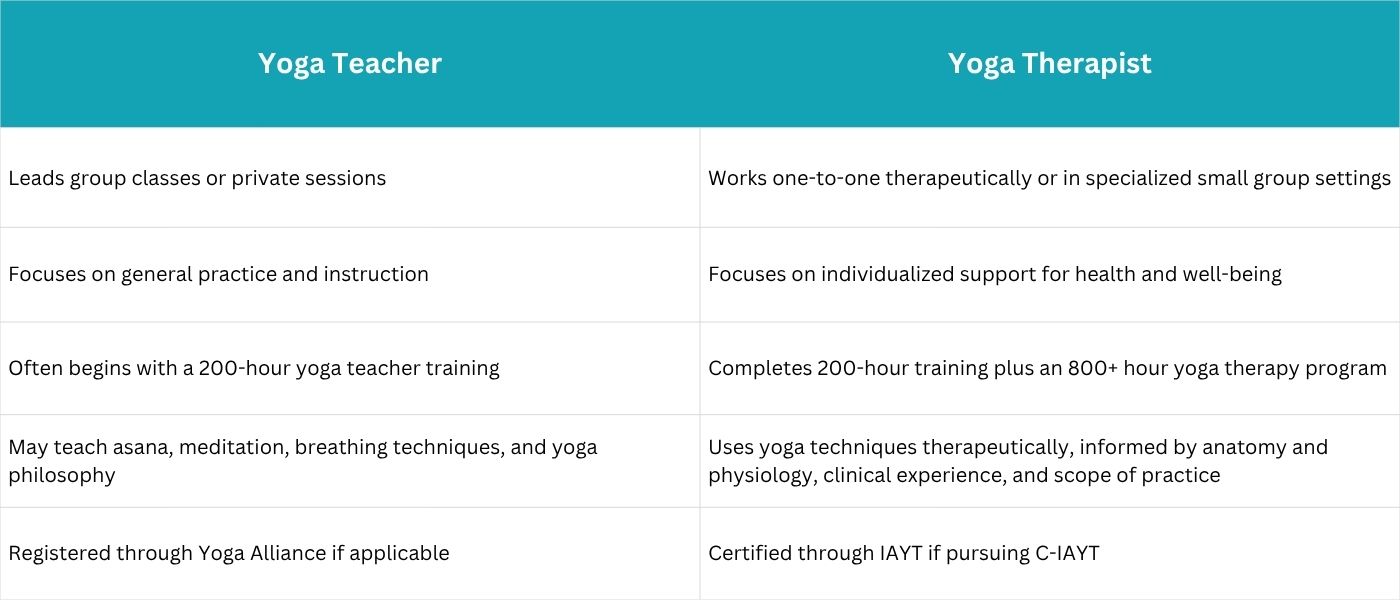
Scope of Practice
This is one of the most important distinctions for anyone researching the field. A yoga therapist does not medically diagnose, prescribe, or replace licensed medical or mental health care. Yoga therapy is a complementary approach. It can support healing, function, regulation, and quality of life, but it is not the same as practicing medicine, psychotherapy, or physical therapy unless someone also holds those licenses.
Because of that, strong training matters. A solid yoga therapy program helps students understand both what they can offer and where the edges are. This includes communication, referral skills, ethics, anatomy and physiology, and how to work in ways that are supportive without stepping outside professional boundaries.

Where Yoga Therapists Work
Yoga therapists work in more places than many people realize. Some build a private practice and specialize in stress, pain, mobility, women’s health, trauma recovery, aging, or chronic illness. Others work in hospitals, rehabilitation centers, mental health clinics, cancer care, nonprofits, schools, or integrative medicine settings.
The setting often shapes the kind of training and clinical experience that will be most useful. Someone who wants to collaborate with healthcare teams may need a different skill set than someone planning to work independently with private clients.
The C-IAYT Credential Explained
If the letters around yoga credentials feel like alphabet soup, you are not alone. The short version is that Yoga Alliance credentials apply to yoga teaching, while C-IAYT is the credential most associated with yoga therapy. These are different tracks, even though many yoga therapists begin as yoga teachers.
That matters because plenty of people assume an advanced yoga teaching credential is enough for therapy work. It is not. A 500-hour yoga teacher training may deepen your knowledge as a yoga teacher, but it does not automatically prepare you for the therapeutic, individualized, and often clinically informed work expected of a yoga therapist.
C-IAYT vs RYT vs CYT: Which Credential Do You Need?
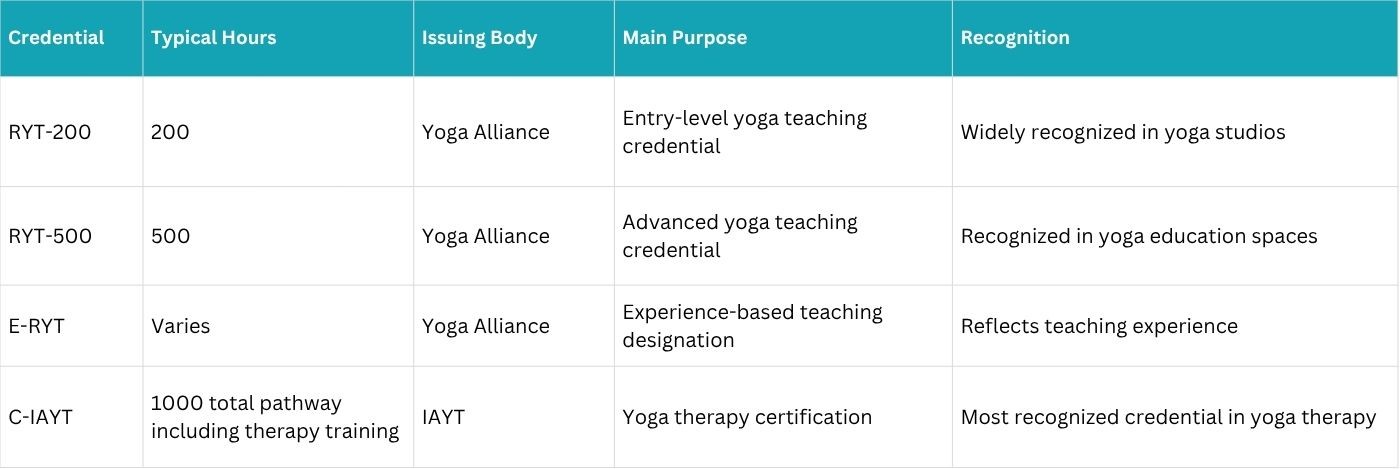
For most people researching how to become a certified yoga therapist, C-IAYT is the credential they are actually looking for. It signals that the practitioner has completed an IAYT-accredited educational pathway and met the organization’s certification standards.

The IAYT Certification Exam
Another detail many older blog posts leave out is the exam requirement. For newer graduates, certification is not only about finishing the hours. It also includes the IAYT certification process, which involves an exam and agreement with the Code of Ethics.
This matters because yoga therapy is becoming more professionalized. The field is still evolving, but there is increasing emphasis on competency, ethics, scope of practice, and professional accountability. For students comparing programs, it is worth asking how the school prepares graduates for the exam and for practice beyond graduation.
Step-by-Step Path to Certification
For many people, the path into yoga therapy unfolds in stages. It is not usually a quick weekend certification or a simple add-on. It is a longer educational process that blends personal practice, teaching experience, study, mentorship, and supervised application.
Step 1. Complete a 200-Hour Yoga Teacher Training
Most people begin with a 200-hour yoga teacher training. This gives you a foundation in yoga philosophy, practice, teaching methodology, anatomy and physiology, and basic instructional skills. If yoga therapy is already on your radar, it helps to choose a program that takes embodiment, ethics, and the therapeutic potential of yoga seriously.
Not every 200-hour program is designed with yoga therapy in mind, but it still serves as the common starting point. It introduces the language, methods, and discipline of the field.
Step 2. Gain Teaching Experience
Many yoga therapy programs want students to have an established personal practice and some real teaching experience before or during training. This makes sense. It is one thing to understand yoga intellectually and another to work skillfully with human beings.
Teaching experience helps you develop observation, pacing, language, and steadiness. It also begins to show you the difference between offering a general class and responding to individual needs.
Step 3. Enroll in an IAYT-Accredited Yoga Therapy Program
This is the major step that moves you from yoga teaching toward yoga therapy. An IAYT-accredited yoga therapy program includes advanced training in therapeutic application, assessment, client relationships, adaptive methods, philosophy, anatomy and physiology, and condition-specific considerations.
These programs are longer for a reason. The work requires more than good intentions. It requires depth, discernment, and the ability to adapt yoga techniques to real human complexity.
Step 4. Complete Clinical Practicum
Clinical practicum is where the work stops being theoretical. This is the stage where students begin supervised client work, often with mentorship, case reflection, documentation, and feedback.
For many trainees, this is the part that most changes their understanding of the field. It teaches you how to listen, assess, adapt, and stay within scope while still being useful and effective.
Step 5. Pass the IAYT Certification Exam
After completing the educational requirements, eligible graduates move into the certification process. This includes the IAYT exam and other professional steps required by the organization.
This stage can feel administrative, but it is also part of a larger shift in the field. Yoga therapy is asking practitioners to meet a more defined standard, which can ultimately support credibility and public trust.
Step 6. Launch Your Practice
Once trained, yoga therapists take different paths. Some start a private practice right away. Others integrate yoga therapy into an existing wellness, healthcare, or mental health role. Some teach and practice both, keeping yoga classes and therapeutic sessions as two distinct offerings.
Launching a practice often takes more than certification alone. It may involve business skills, mentorship, networking, professional liability coverage, and ongoing continuing education.

How Much Yoga Therapy Certification Costs
Cost is one of the biggest questions people have, and one of the least clearly explained. Tuition is only part of the story. The full investment depends on the kind of program you choose, where it is based, whether it is online or residential, and what extra expenses come with it.
That is why it helps to think in ranges rather than looking for one universal number. A lower-cost online pathway and a university-based program can both lead into the field, but they may come with very different structures, support levels, and financial realities.
Tuition Ranges by Program Type

The right choice is not always the cheapest or the most expensive. A lower-cost program may still be excellent if it offers strong mentorship, skilled faculty, and meaningful practicum support. A higher-cost program may offer institutional resources or a particular specialization that matters for your path.
Hidden Costs Beyond Tuition
The full cost of becoming a yoga therapist usually includes more than published tuition. Depending on the program, students may also need to budget for textbooks, props, travel, lodging, professional memberships, liability insurance, exam fees, and supervision-related expenses.
There can also be costs that arrive later, such as continuing education, certification renewal, and business expenses if you open a private practice. This is where many students get caught off guard. The tuition number looks manageable until the surrounding costs start stacking up.
Financial Aid and Scholarships
Some programs offer payment plans, and some offer partial scholarships. University-based programs may have access to funding models that independent schools do not. It is worth asking direct questions early, especially if affordability will shape your decision.
It is also wise to ask what is included. One program’s tuition may cover mentoring, practicum support, and materials, while another may list a lower tuition but charge separately for important pieces of the training.
Choosing the Right Training Program
There is no single best yoga therapy program for everyone. The better question is which program best fits your life, learning style, goals, and future work. A strong decision starts by being honest about what you need, not just what sounds impressive on paper.
Before enrolling, it helps to ask a few practical questions. Do you need an online format because of your schedule? Do you want a more immersive experience? Are you hoping to work in healthcare settings, mental health, private practice, or a spiritual wellness context? Do you need close mentorship, or are you comfortable with more independent learning?
Online vs Hybrid vs Residential Programs
Online programs can be a good fit for working adults, parents, or professionals who need flexibility. But flexible does not mean passive. In yoga therapy, many online hours are still live, interactive, and demanding.
Hybrid programs offer a middle path. They allow some of the convenience of remote learning while preserving in-person training time. Residential formats can be powerful for immersion and community, but they often come with greater expense and more life disruption.
What to Look for in a Program
The first question is simple. Is the program IAYT-accredited? If not, that is an immediate concern for anyone who wants the recognized yoga therapy pathway.
Beyond that, look at faculty credentials, practicum quality, mentorship structure, curriculum depth, and whether the program covers both yoga philosophy and the applied dimensions of working with people. You want a program that respects yoga as a healing modality while also preparing you for the actual demands of therapeutic work.
Red Flags in Training Programs
Be careful with any program that uses the phrase yoga therapy loosely without being connected to recognized standards. Also pay attention to promises that sound too fast, too vague, or too easy.
If a school cannot explain its practicum, has little detail about faculty preparation, or suggests you will be fully prepared for therapeutic work in a surprisingly short time, pause there. This is a field where depth matters.
The Mental Health Professionals Pathway
For counselors, therapists, psychologists, and other licensed professionals, yoga therapy can be a meaningful expansion of practice. It offers another way of working with regulation, embodiment, stress, trauma, and health and well-being through direct experience rather than talk alone.
At the same time, entering yoga therapy from a clinical background can be humbling. You may already have strong relational and assessment skills, but yoga therapy still asks for its own discipline. It includes practice-based knowledge, embodied learning, breathing techniques, yoga philosophy, and the therapeutic use of yoga methods in ways that are not identical to psychotherapy.
Which Hours Transfer
Some programs may accept a portion of prior education or clinical experience, especially for licensed healthcare or mental health professionals. How much transfers varies widely by school.
That means it is worth asking detailed questions instead of assuming your previous training will automatically reduce your hours. Even when some coursework transfers, most programs still expect students to engage the yoga-specific and practicum-based parts of the pathway in full.
Scope of Practice Integration
For mental health professionals, one of the most useful questions is not just whether you can add yoga therapy, but how you will hold the boundary between your roles. In some cases, the combination can be powerful. In others, it requires careful thought about billing, documentation, informed consent, and the difference between psychotherapy and yoga therapy.
This is where strong education matters again. The more mature your training, the more likely you are to integrate the work skillfully rather than blending everything together in a way that becomes muddy for you or your clients.
Yoga Therapist Salary and Career Outlook
One of the most common questions people ask is how much yoga therapists actually make in the United States. The honest answer is that income varies widely by work setting, location, specialization, and whether you are employed by an organization or building a private practice. Current salary snapshots also differ by source. ZipRecruiter’s national page lists an average annual salary around $58,444, while Indeed’s current national page lists an average around $78,706 based on recent job-posting data. That gap tells you something important right away. This is still a small and uneven field, so compensation data can swing depending on how each platform gathers its numbers.
Private practice can look very different from salaried work. Breathing Deeply notes that many yoga therapists charge rates comparable to other helping professionals in private practice, and its salary guide cites national earnings around $70,000 annually while also pointing to higher potential depending on niche and market. Their job-market article says yoga therapists in wellness centers or public health settings may earn anywhere from $25 to $120 per hour.
Salary ranges by setting
In private practice, session rates are often market-dependent, and many practitioners land somewhere in the broad range of $75 to $200 per session in stronger markets or specialized niches. In salaried or organizational settings, compensation is often steadier but may be lower than high-end private rates. Current public salary tools suggest a broad employed range that often lands somewhere between the upper $40,000s and upper $70,000s, depending on source and geography. A mixed income model is often the most realistic path, with practitioners combining private clients, group programs, workshops, contract work, or part-time institutional roles.
Factors that affect earning potential
Location matters a great deal. Urban markets and higher-income regions often support higher rates, while rural areas may require lower pricing or a broader mix of services. Specialization also matters. A yoga therapist focusing on chronic pain, cancer support, nervous system regulation, mental health, or rehabilitation often has a clearer referral pathway than someone offering only general wellness support. Experience and reputation shape income over time as well, especially in private practice where trust, referrals, and communication skills matter. The structure of your work matters too. An employed role may offer more predictability, while private practice offers more room for growth but also more responsibility.
Job market and growth
Yoga therapy is still a relatively small profession, but it is being taken more seriously in integrative and complementary health settings. Breathing Deeply points to work opportunities in schools, hospitals, rehab centers, wellness centers, and public health settings. IAYT presents yoga therapy as a global professional field, representing practitioners in more than 50 countries, which reflects a broader institutional presence than many people realize. As research and whole-person care models continue to influence healthcare and wellness, the field appears to be expanding gradually rather than exploding overnight.
Specialization Options for Yoga Therapists
One of the strengths of this field is that you do not have to stay general forever. Many yoga therapists begin with broad training, then gradually focus on the populations or conditions they feel most prepared to serve.
Clinical specializations
Clinical specialization often includes work with chronic pain, musculoskeletal conditions, cardiovascular and respiratory health, nervous system disorders, digestive issues, endocrine imbalance, reproductive health, and cancer support. The Yoga Therapy Institute’s module listings show just how condition-specific this training can become, with dedicated study in musculoskeletal issues and lower back pain, cardiovascular and respiratory issues, nervous system and degenerative disease, digestive concerns, endocrine and immune disorders, and reproductive health.
Population-based specializations
Some yoga therapists specialize less by diagnosis and more by population. That may include trauma-informed care, pediatric support, older adults, prenatal and postpartum care, addiction recovery, or mental health-focused work. SomaYoga’s overview mentions areas such as stress management, chronic pain, and addiction, while The Yoga Therapy Institute explicitly includes ageing populations, adolescents, family dynamics, fertility, pregnancy, menopause, and vulnerable groups within its reproductive and life-stage training.
State Licensure and Legal Considerations
Many readers also want to know whether yoga therapists need a license and whether they can legally call themselves a yoga therapist.
Current regulatory landscape
At this time, there is no federal licensure for yoga therapy in the United States. Breathing Deeply states that, as of its published guidance, you may call yourself a yoga therapist in all 50 U.S. states and in Canada. At the same time, the broader regulatory picture can shift over time, and some schools advise students to check state-specific rules as professional regulation evolves. In practice, C-IAYT functions as the strongest widely recognized professional benchmark, even though it is a certification rather than a government license.
Protecting your practice
Even without state licensure, professional responsibility still matters. That means carrying professional liability insurance, working within scope, documenting your role clearly, and following an ethical framework such as the IAYT Code of Ethics if you are on the certification path. The field may not be state-licensed in the same way as physical therapy or psychotherapy, but it still asks for maturity, boundaries, and careful communication.
Becoming a yoga therapist is a structured path that asks for time and engagement with the work. When you understand the steps, costs, and expectations, the process becomes clearer. If this path calls to you, start where you are, ask questions, and choose training that truly prepares you to serve.
FAQ
Is 40 too old to become a yoga therapist?
Not at all. Many people enter yoga therapy after another career, after raising a family, or after years of practice and teaching. In many cases, maturity is an asset. This field asks for listening, discernment, steadiness, and lived experience, not just physical performance or youth. A later start can actually serve the work well.
Can you become a yoga therapist online?
Yes, much of the training can now be completed online through accredited schools, but online does not always mean fully self-paced. Strong programs usually still require live participation as per IAYT requirements, supervised practicum, mentorship, and case-based learning. What matters most is not whether the training is online, but whether it is reputable, rigorous, and aligned with IAYT standards.
What is the IAYT certification exam like?
The exam is part of the certification process for newer applicants and is designed to assess whether graduates understand professional standards, ethics, scope of practice, and the applied use of yoga therapy principles. It is not focused on memorization alone. Instead, it reflects real-world thinking, including how to work with clients appropriately, stay within boundaries, and apply training in a practical setting. Most strong programs prepare students for this through case-based learning, mentorship, and clinical experience rather than test-specific study alone.
Do I need a college degree to become a yoga therapist?
Not always. Requirements vary by school, not by one single national rule. Many programs focus more on prior yoga training, readiness for professional study, and the ability to complete the curriculum successfully. Some university-based pathways may have additional academic expectations, but a college degree is not universally required across the field.
How is yoga therapy different from physical therapy?
Physical therapy is a licensed healthcare profession centered on rehabilitation and medical treatment of movement and function. Yoga therapy is a complementary discipline that uses yoga practices to support health and well-being within its own scope. They can work alongside each other, but they are trained differently, regulated differently, and serve different professional roles.
Can yoga therapists accept insurance?
Usually, not directly, unless they also hold another license that allows billing under that separate profession. Some clients may use HSA or FSA funds or seek reimbursement on their own, but that depends on the plan and the provider. Most yoga therapy income still comes through private pay, organizational employment, or contract-based work.
Turn study into service
Yoga Therapy Certification
Explore a comprehensive path toward becoming a professional yoga therapist.
Explore Yoga Therapy Training