
Sound Healing for Yoga Teachers
In this article
Three Practices for Using Sound Healing in a Yoga Class
Sound Healing can deepen a yoga class, but a good experience depends on more than the instruments you own.
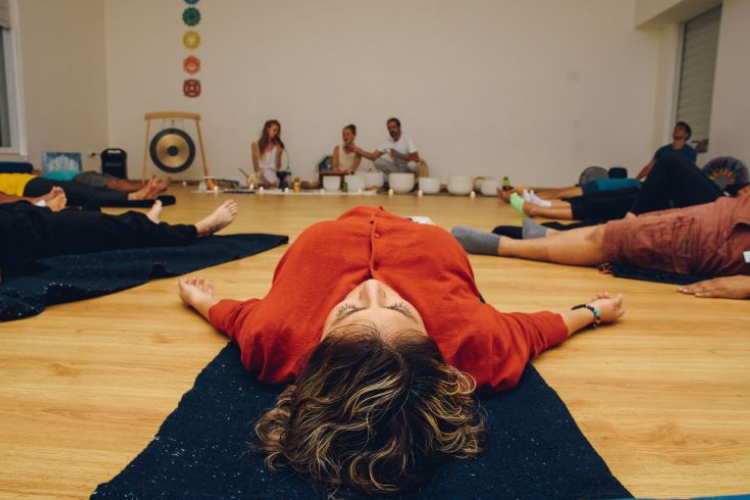
Sound Healing fits naturally into yoga. One bowl tone can help students arrive. A gentle drone can draw attention to the breath. Humming lets students feel the exhale as vibration. Chimes can mark transitions, and carefully placed sound can make savasana more restful.
Simply bringing instruments into the room, however, does not guarantee a helpful experience.
Through my years at Soul of Yoga, I have participated in and observed thousands of sound healings, sound baths, yoga classes with sound, and other sound experiences. What I have noticed is fairly simple. Good sound experiences help people feel safe, take the nervous system into account, and use sound with musical intention.
You can apply these ideas with a single chime or a room full of crystal singing bowls. Learning to use one sound well is often more useful than collecting instruments without knowing how they work together.
These are the three practices I come back to most often.
1. Make the Experience Feel Safe
Sound may be soothing, but it can also be intense. A sudden gong strike, an instrument played close to someone’s head, or a sharp jump in volume might delight one student and overwhelm another. We cannot know everything our students are carrying into the room. A trauma-informed approach gives them predictability, choice, and respect for their personal boundaries.
Before you play, tell students what to expect. Name the instruments you plan to use, when the sound will begin, and whether the volume or intensity may change. Let them know if you will walk around the room. Ask for consent before playing an instrument near someone’s body.
Offer real options. Students may want to change position, move farther away, sit up, or step outside. Invite participation in humming, mantra, or toning rather than requiring it. A simple phrase such as “You are welcome to receive the sound in whatever way feels supportive today” reminds students that they remain in charge of their own experience.
Pay close attention to volume. Sound does not need to be loud to be meaningful, and greater intensity does not make it more effective. In sensitive settings, steady tones, grounding instruments, and gradual changes are usually easier to receive than sudden strikes or a dense wall of sound.
If discomfort comes up, offer students a few simple ways to respond. They can notice their breath, feel the floor beneath them, open their eyes, look around the room, or create more distance from the instrument. Your role is to create clear conditions in which they can listen to themselves.
2. Design the Sound for Nervous System Regulation
Many yoga teachers turn to sound to help a class move from effort and stimulation toward rest. How you shape the sound matters as much as the instrument you choose.
Slower tempos, softer volume, repetition, long decays, gentle humming, and steady drones can create a sense of continuity. Predictable sound asks less of the orienting response than rapid, irregular, or startling changes. Silence also matters. The quiet after a tone gives the nervous system time to receive what it has heard.
Research offers some support for these observations, although the field is still developing. A randomized controlled trial of Tibetan singing bowl sounds reported changes consistent with an acute relaxation response, including increased heart-rate variability. Research on yoga mantras and rhythmic prayer has also found that vocal repetition can slow breathing and influence cardiovascular rhythms. The findings are encouraging, but people do not all respond to the same instrument or frequency in the same way.
For practical teaching, ask, “What kind of sound supports the state I am trying to cultivate in this part of class?”
During active movement, a light rhythmic foundation can support the practice without competing with breath, alignment, or verbal instruction. In yin or restorative yoga, sustained tones and spacious repetition often complement longer holds. During yoga nidra, keep the voice primary and let instruments support the guidance. For savasana, try a simple arc. Begin gently, allow the sound to develop, then remove layers and leave time for silence.
Your voice may be the most accessible tool you have. Humming, extended vowel sounds, Om, mantra, and similar practices naturally join sound with the exhale. Students create the vibration themselves, so the practice feels participatory and embodied instead of being something done to them.
Keep watching the room while you play. Notice changes in breathing, restlessness, facial tension, and the overall energy of the group. If students seem activated, more sound may not help. Try simplifying, softening, repeating a familiar tone, or pausing.
3. Let Musicality Do Some of the Healing
You do not need to be a professional musician to use sound in yoga. Still, a little musical understanding goes a long way.
When instruments are played together, listeners hear the relationships between them, not only the individual sounds. Harmony can feel stable, open, and pleasing. Dissonance can add tension, movement, or complexity. Both have a place, but accidental dissonance or poor tuning can make a relaxation experience feel unsettled.
A practical place to begin is with consonant intervals such as thirds, fourths, and fifths. Major triads offer a simple structure built from a root, third, and fifth. A C-major triad, for example, contains C, E, and G. If you have several bowls or other pitched instruments, choosing notes from one triad can help them sound more coherent together.
Tuning matters just as much as note names. Two instruments may both be labeled C yet be far enough apart in pitch to create obvious beating or roughness when played together. A tuner app can show the note, octave, tuning reference, and how many cents the sound is sharp or flat. Many listeners may not consciously identify a difference of 15 cents or less when notes are played separately. When sustained tones are played together, even a small difference may become audible as beating or shimmer.
Dissonance and being out of tune are related, but they are not the same. Dissonance is the tension or complexity we hear between sounds, and it can be intentional. An instrument is out of tune when it misses the pitch relationship you intended. If two bowls are meant to match and one is noticeably higher, the main issue is a tuning mismatch, even if the result also sounds dissonant.
The same point applies to the familiar “432 versus 440” discussion. Current research does not establish that one specific frequency is universally healing. A tuning reference tells a tuner where to place the pitch center. It does not guarantee that a group of instruments will sound harmonious. In practice, it is more useful to know your reference, understand how your instruments relate to each other, and listen carefully.
Leave some space in the experience. Play fewer instruments, let each sound complete its decay, and listen before adding another layer. Restraint creates room for the sound to land. Silence gives it contrast. Musicality comes down to choosing what serves the moment.
Start Simple and Keep Listening
Sound can support many parts of a yoga class, including opening and closing rituals, breathwork, mantra, transitions, longer-held postures, meditation, yoga nidra, and savasana. Start with the instrument you already have, or with your own voice. Focus on creating clear expectations, supporting the state you want to cultivate, and making musical choices that work together.
In the three-hour online training Sound Healing for Yoga Teachers, we will look at why sound complements yoga and how to use it in different class formats. We will also cover practical theories for how sound may work, accessible instruments, musicality, tuning, and ways to create an experience that is pleasant and supportive of the nervous system.
No instruments or previous sound healing experience are required.
Sound Healing for Yoga Teachers
Online via Zoom | August 22, 2026 | 9:00 a.m.–12:00 p.m. Pacific
About Ryan Stanley
Ryan Stanley is a parent, spouse, yoga teacher, sound healer, and conscious business owner. His work spans yoga, sound healing education, sound instruments, audio, and professional music settings.
As owner of Soul of Yoga, Ryan has participated in and observed thousands of sound healings, sound baths, yoga classes with sound, and other sound experiences. He co-founded Soul of Yoga’s Sound Institute, active from 2018 through 2024, where he helped bring many of the world’s most renowned sound healing teachers to serve as faculty.
Ryan studied in this environment, became an advanced sound healer, spent time with many master teachers, and went on to conduct private and group sound healings, teach yoga classes with sound, and support sound healing students.
Ryan also co-founded Sacred Sound of the Soul, a sound healing instrument company that has helped thousands of customers connect with sound healing instruments and now focuses on Crystal Tones Alchemy Crystal Singing Bowls. His audio background includes sound engineering, broadcasting, production of a sound healing album with Grammy-nominated vocalist Silvia Nakkach, and concert and studio work as a singing bowl musician with Grammy-winning artist LeAnn Rimes.
Selected Sources
Río-Álamos, C., et al. (2023). “Acute Relaxation Response Induced by Tibetan Singing Bowl Sounds: A Randomized Controlled Trial.” European Journal of Investigation in Health, Psychology and Education, 13(2), 317–330. View source
Bernardi, L., et al. (2001). “Effect of Rosary Prayer and Yoga Mantras on Autonomic Cardiovascular Rhythms: Comparative Study.” BMJ, 323(7327), 1446–1449. View source
Stanhope, J., & Weinstein, P. (2020). “The Human Health Effects of Singing Bowls: A Systematic Review.” Complementary Therapies in Medicine, 51, 102412. View source
Chanda, M. L., & Levitin, D. J. (2013). “The Neurochemistry of Music.” Trends in Cognitive Sciences, 17(4), 179–193. View source
Continue your study
Continue Your Study at Soul of Yoga
Sound is one of many ways to deepen your practice and teaching. Explore our study areas to see what you would like to learn next.
Explore Yoga Study Areas