

In this article
- A Practical Guide for Yoga Teachers Ready to Go Deeper
- What IAYT Accreditation Actually Means for Online Programs
- The 800-Hour Curriculum: What It Covers and Where Online Delivery Works Well
- Where Online Yoga Therapy Training Loses Fidelity: The Practicum Problem
- The Hybrid Advantage: Why In-Person Intensives Change the Outcome
- Prerequisites and What to Expect Before You Enroll
- A Framework for Evaluating Any Online Yoga Therapy Program
- Why the C-IAYT Credential Matters for Your Yoga Therapy Career
- Frequently Asked Questions
- Is online yoga therapy training legitimate?
- What are the prerequisites for yoga therapy certification?
- How do online yoga therapy programs handle practicum hours?
- What is the difference between therapeutic yoga and yoga therapy?
- How long does it take to become a certified yoga therapist?
- How much does online yoga therapy training cost?
- Can I do yoga therapy training if I am not a Yoga Alliance member?
- Is Soul of Yoga’s yoga therapy program IAYT-accredited?
Yes, you can complete yoga therapy training online through IAYT-accredited programs. Understanding how accreditation standards apply to virtual delivery, how practicum hours work remotely, and what separates a rigorous online program from a low-quality one will help you invest wisely.
Key Takeaways
- IAYT-accredited yoga therapy training is available online, with tuition ranging from approximately $9,324 to $14,000 depending on the format and school.
- All accredited programs require a 200-hour yoga teacher certification and at least one year of active teaching experience before enrollment.
- Practicum hours, which total 150 hours of supervised clinical client work, are the most difficult component to deliver virtually, and how any school handles this requirement is the single most important quality indicator.
- Hybrid yoga therapy programs that combine online coursework with in-person intensives or structured live synchronous sessions consistently produce the strongest clinical outcomes and best prepare students for real-world practice.
- IAYT accreditation is the only credential that leads to the C-IAYT designation, which is the recognized professional standard for certified yoga therapists and the benchmark employers and healthcare partners use to evaluate practitioners.
If you’d like to learn how to become a Certified Yoga Therapist (C-IAYT) go here.
A Practical Guide for Yoga Teachers Ready to Go Deeper
If you are a certified yoga teacher researching whether online yoga therapy certification is legitimate, rigorous, and worth the significant investment of time and money, the short answer is yes.
IAYT-accredited programs exist in virtual, hybrid, and in-person formats, and the credential you earn through each of them can lead to the same C-IAYT designation that marks you as a certified yoga therapist in the eyes of healthcare systems, integrative health clinics, and private clients.
But “can you” and “should you, through any particular program” are meaningfully different questions, and the gap between them is where most prospective students get misled by marketing that prioritizes enrollment over honest disclosure.
This guide breaks down exactly what a quality 800-hour yoga therapy program covers, which components of the curriculum translate well to online delivery, where virtual training loses fidelity, and how to evaluate any program using an evidence-based framework before you write a check.
If you are curious about the difference between a yoga instructor and a Yoga Therapist, go here.
What IAYT Accreditation Actually Means for Online Programs
The International Association of Yoga Therapists (IAYT) is the accrediting body that sets the educational standards for yoga therapy certification programs in North America and internationally.
An IAYT-accredited program is one that has been reviewed and approved in accordance with the organization’s Educational Standards, which specify the content domains, clinical hour requirements, faculty qualifications, and delivery methods that constitute an acceptable path to the C-IAYT credential.
For online yoga therapy training specifically, IAYT standards require that most program hours be delivered synchronously, meaning that live interaction between faculty and students is not optional window dressing but a core accreditation requirement. This is an important point because it distinguishes legitimate programs from self-paced certificate courses that carry no professional standing.
When you see a yoga therapy certification advertised as fully asynchronous or entirely self-paced, that is a strong signal the program is not IAYT-accredited, regardless of how it is marketed.
What IAYT accreditation does not guarantee on its own is the quality of the online delivery infrastructure, the depth of mentorship available to remote students, or how well the school has adapted its clinical training for virtual formats. Accreditation is a floor, not a ceiling, and comparing accredited programs against one another requires looking beyond the credential itself.

The 800-Hour Curriculum: What It Covers and Where Online Delivery Works Well
An 800-hour yoga therapy program is a graduate-level professional training by scope if not always by institutional affiliation. The curriculum spans several broad domains: yoga philosophy and ethics as they apply to therapeutic contexts; anatomy, physiology, and pathophysiology relevant to yoga practice; psychological and mental health foundations; yoga therapy assessment and client intake skills; individual session design and protocol development; and the supervised clinical practicum that integrates all of the above with real clients.
Of these components, the academic and conceptual content translates well to online delivery. Lecture-based learning covering anatomy, physiology, pathology, yogic philosophy, psychology, and scope of practice can be delivered effectively through a combination of on-demand video modules and synchronous seminars.
Students who are already experienced yoga teachers bring substantial prior knowledge to these topics, which means they are learning refinements and clinical applications rather than foundational concepts from scratch, and that context makes self-directed study that does take place in most trainings more efficient.
Case study analysis, peer discussion, and theoretical frameworks for clinical yoga therapy assessment also work well in virtual formats when programs use structured synchronous sessions that replicate seminar learning.
Many students in online yoga therapy programs report that the flexibility to review recorded lectures, revisit material on asynchronous modules, and attend live seminars from their home practice space is a genuine educational advantage for this stage of their career, when teaching schedules, family obligations, and geographic distance from training centers are real constraints.

Where Online Yoga Therapy Training Loses Fidelity: The Practicum Problem
The section of any online yoga therapy curriculum that requires the most scrutiny is the practicum, and this is the area where program quality varies most dramatically and where marketing language is most likely to obscure reality.
IAYT-accredited programs require a minimum of 150 hours of supervised clinical practice with actual clients, individuals seeking yoga therapy for real health conditions. These hours must be supervised, meaning a qualified mentor reviews your work, provides feedback on your clinical reasoning, and assesses your developing competency in therapeutic relationship, intake and assessment, session design, and outcome tracking.
In a traditional in-person program, this supervision happens with direct observation: a faculty member watches you work with a client, gives real-time or post-session feedback, and can assess the subtleties of your verbal communication, your ability to read and adapt to a client’s physical and emotional state, and your clinical judgment in the room. Online delivery can change this dynamic in ways that range from manageable to significant depending on how the program has designed its supervision model.
Programs that handle online practicum well use video review of recorded student sessions combined with structured one-on-one mentorship calls, written case documentation requirements, and cohort-based peer supervision groups that are themselves supervised by faculty.
The best online yoga therapy programs have designed practicum models that are more rigorous in documentation and reflection than many in-person programs, precisely because they cannot rely on proximity to fill the gap. Programs that handle online practicum poorly offer minimal mentorship, and graduate students who have logged practicum hours without developing the clinical discernment those hours are supposed to build.
When evaluating any online yoga therapy certification, ask specifically:
- How many mentorship hours are included in the practicum?
- Who are the supervisors and what are their backgrounds?
- How are sessions reviewed, and what is the feedback mechanism?
- What happens if a student’s clinical skills are not progressing adequately?
The answers to these questions tell you far more about program quality than the marketing copy does.
The Hybrid Advantage: Why In-Person Intensives Change the Outcome
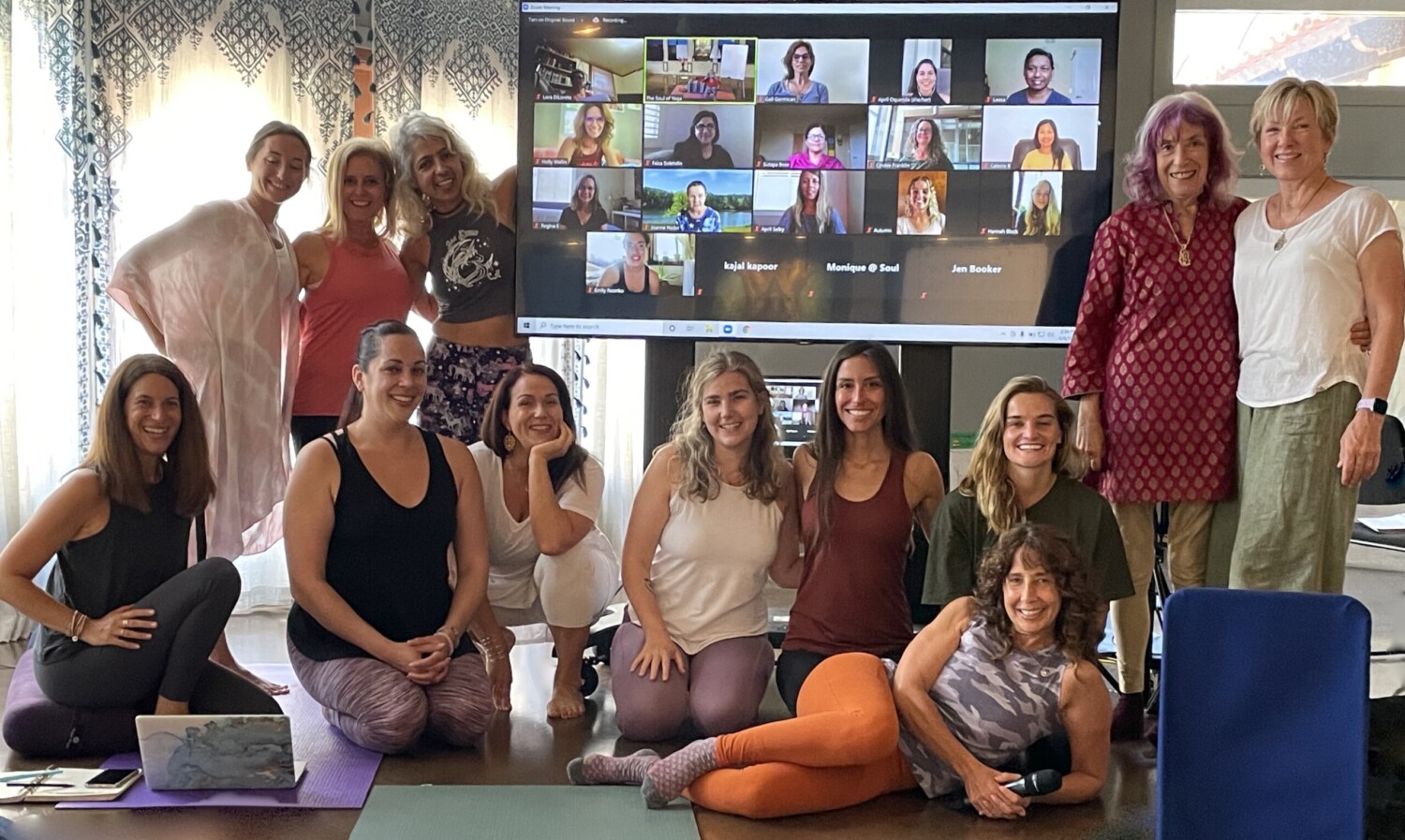
The strongest online yoga therapy programs are not purely virtual. They are hybrid training models that use online delivery for the academic and didactic content where it is most efficient, and the option of in-person intensives for the embodied, clinical, and relational skills where physical presence adds irreplaceable value.
In-person intensives within a hybrid yoga therapy program typically address hands-on assessment techniques, the therapeutic application of physical assists and adjustments, observing postural patterns and compensatory movement habits in real bodies, and the quality of presence and attunement that is core to a therapeutic relationship but can be difficult to teach or assess over video. Even three to five days of in-person immersion distributed across an 800-hour program creates a qualitatively different learning experience than fully virtual delivery, because it gives students and faculty a shared physical reference point for the clinical work they continue online. That said, some schools have dedicated themselves to refine how they teach online so it’s a good idea to get a sense of their attention to this.
For yoga teachers weighing online yoga therapy certification options, a hybrid model with well-designed in-person components is worth a higher tuition investment than a fully virtual program, not because online learning is inferior in principle, but because the specific skills that define clinical yoga therapy practice are strengthened by embodied learning in a way that current virtual technology cannot fully replicate.
Prerequisites and What to Expect Before You Enroll
Regardless of delivery format, every IAYT-accredited yoga therapy certification program requires a 200-hour yoga teacher training as a prerequisite, and most programs also require at least one year of active teaching experience. Some programs specify an RYT-200 credential from a Yoga Alliance registered school; others accept equivalent training that meets the same hour and content standards. If your yoga teacher training was completed through a non-Yoga Alliance school or in a tradition that does not use that registration system, contact programs directly to confirm your eligibility before investing time in their application process.
The 200-hour prerequisite is not a formality. Yoga therapy training at the 800-hour level assumes you have a functional teaching practice, a working knowledge of asana and pranayama, and some practical experience observing how yoga affects different bodies and different populations. Students who enroll without adequate teaching experience typically find the clinical training difficult to integrate because they are still learning foundational teaching skills simultaneously with advanced clinical ones.
Beyond the teaching prerequisite, prospective students should budget realistically for the full commitment. Tuition for accredited online yoga therapy programs ranges from approximately $9,324 to $14,000, with hybrid programs tending toward the higher end of that range due to the infrastructure costs of in-person intensives. The total time commitment for an 800-hour program typically spans two to four years and the synchronous hour requirements mean you will need to protect regular blocks of time in your schedule for live sessions regardless of how much of the curriculum is available on demand.
A Framework for Evaluating Any Online Yoga Therapy Program
Before enrolling in any online yoga therapy certification, use these criteria to evaluate what you are actually buying.
- Accreditation status: Confirm current IAYT accreditation, not pending or provisional accreditation, on the IAYT website directly rather than through the school’s marketing materials.
- Synchronous hour requirements: Ask what percentage of the 800 hours is live and synchronous, what platform is used, and whether recordings are available for students who cannot attend live due to time zone or schedule conflicts.
- Practicum structure: Request the specific breakdown of mentorship hours, the qualifications of practicum supervisors, and the documentation process for client sessions.
- Faculty credentials: Confirm that the faculty holding C-IAYT credentials are actively involved in teaching and supervision, not just listed for accreditation purposes.
- Graduate outcomes: Ask the school for data on graduate completion rates, C-IAYT exam pass rates, and where alumni are working in yoga therapy roles.
- Hybrid components: Clarify whether in-person intensives are required or optional, where they are held, and what content they cover.
A school that answers these questions transparently and in detail is a school that is confident in what it has built. Evasive, vague, or sales-focused responses to clinical and structural questions are a reason to look elsewhere.
Why the C-IAYT Credential Matters for Your Yoga Therapy Career
The end goal of completing an IAYT-accredited 800-hour program is eligibility to sit for the C-IAYT credentialing exam and earn the certified yoga therapist designation that signals professional standing to employers, healthcare systems, and clients. This credential is not equivalent to a yoga teacher certification or a continuing education certificate in therapeutic yoga. It represents a defined scope of practice, an ethical framework, and a level of clinical training that positions yoga therapy within the broader integrative health landscape alongside other licensed and certified complementary health practitioners.
Healthcare systems, hospital-based integrative medicine programs, cancer centers, mental health clinics, and private practice clients who seek yoga therapy specifically are increasingly using the C-IAYT credential as their baseline for vetting practitioners. Building a yoga therapy career, whether in private practice, in clinical settings, or in educational roles training future yoga therapists, is significantly more viable with the credential than without it, which is why the accreditation status of the program you choose is not a technical detail but a career-defining decision.
Average yoga therapist salaries range from $70,000 to $100,000 annually depending on setting and location, with Glassdoor reporting an average of $99,837. The broader context supports that demand: the US yoga market is valued at approximately $12 billion and growing at 9.8 percent annually, and healthcare systems are increasingly incorporating non-pharmacological interventions in response to patient demand and mounting evidence for their effectiveness.
Online yoga therapy training that leads to C-IAYT eligibility is real, rigorous, and accessible in a way that in-person-only programs are not for most working yoga teachers. The key is choosing a program that has designed its virtual delivery intentionally, particularly around clinical training, and that gives you honest answers about what online learning can and cannot do.
Frequently Asked Questions
Is online yoga therapy training legitimate?
Yes, online yoga therapy training is legitimate when the program holds current IAYT accreditation. IAYT-accredited programs are evaluated against the same Educational Standards regardless of delivery format, and completing an accredited program makes you eligible for the C-IAYT credentialing exam. Programs that are not IAYT-accredited, no matter how they are marketed, do not qualify you for the C-IAYT credential and do not carry the same professional standing.
What are the prerequisites for yoga therapy certification?
All IAYT-accredited yoga therapy certification programs require a minimum 200-hour yoga teacher training as a prerequisite, and most also require at least one year of active teaching experience. Some programs specify an RYT-200 Yoga Alliance credential, while others accept equivalent training. You should confirm your specific eligibility with any program you are considering before applying.
How do online yoga therapy programs handle practicum hours?
Practicum hours in online yoga therapy programs are typically completed with clients in the student’s own community, supervised remotely through a combination of recorded session review, written case documentation, individual mentorship calls with a qualified clinical supervisor, and peer supervision groups. The quality of this supervision model varies significantly between programs, and the depth of mentorship available to each student is the most important factor to evaluate when comparing online options.
What is the difference between therapeutic yoga and yoga therapy?
Therapeutic yoga is a general term for yoga practices adapted for health and wellness purposes, and it does not require any specific credential or training standard. Yoga therapy, as defined by IAYT, is a professional discipline practiced by C-IAYT certified yoga therapists who have completed an accredited 800-hour program and passed a credentialing exam. Clinical yoga therapy involves individualized assessment, session design, and outcome tracking for clients with specific health conditions, and it operates within a defined scope of practice that distinguishes it from group yoga instruction.
How long does it take to become a certified yoga therapist?
The timeline to become a C-IAYT certified yoga therapist depends on the program and your schedule, but most students working alongside an active teaching career complete an 800-hour online or hybrid program in two to four years. After completing the program, you apply for C-IAYT credentialing through IAYT, which includes submitting documentation of your training hours, practicum work, and passing the credentialing examination.
How much does online yoga therapy training cost?
Tuition for IAYT-accredited online yoga therapy programs ranges from approximately $9,324 to $14,000. Fully virtual programs tend to sit at the lower end of that range, while hybrid programs that include in-person intensives typically cost more due to the additional resources required. Payment plans are commonly available, and some programs offer early enrollment discounts or alumni pricing for continuing education.
Can I do yoga therapy training if I am not a Yoga Alliance member?
Yoga Alliance membership is separate from RYT-200 registration, and most IAYT-accredited programs specify a 200-hour yoga teacher training as their prerequisite rather than Yoga Alliance membership specifically. What is among the most important is that your yoga teacher training meets the hour and content standards the program requires. If your training was completed outside the Yoga Alliance registration system, contact the program directly to confirm whether your background satisfies their prerequisite requirements.
Is Soul of Yoga’s yoga therapy program IAYT-accredited?
Soul of Yoga offers an IAYT-accredited 800-hour yoga therapy training program. The program uses a hybrid model that combines online coursework with structured synchronous sessions and in-person training components, designed to deliver both the academic rigor and the clinical skill development that the C-IAYT credential requires. For current program details, schedule, and enrollment information, visit the Soul of Yoga Institute or contact the admissions team directly.
Turn study into service
Yoga Therapy Certification
Explore a comprehensive path toward becoming a professional yoga therapist.
Explore Yoga Therapy Training